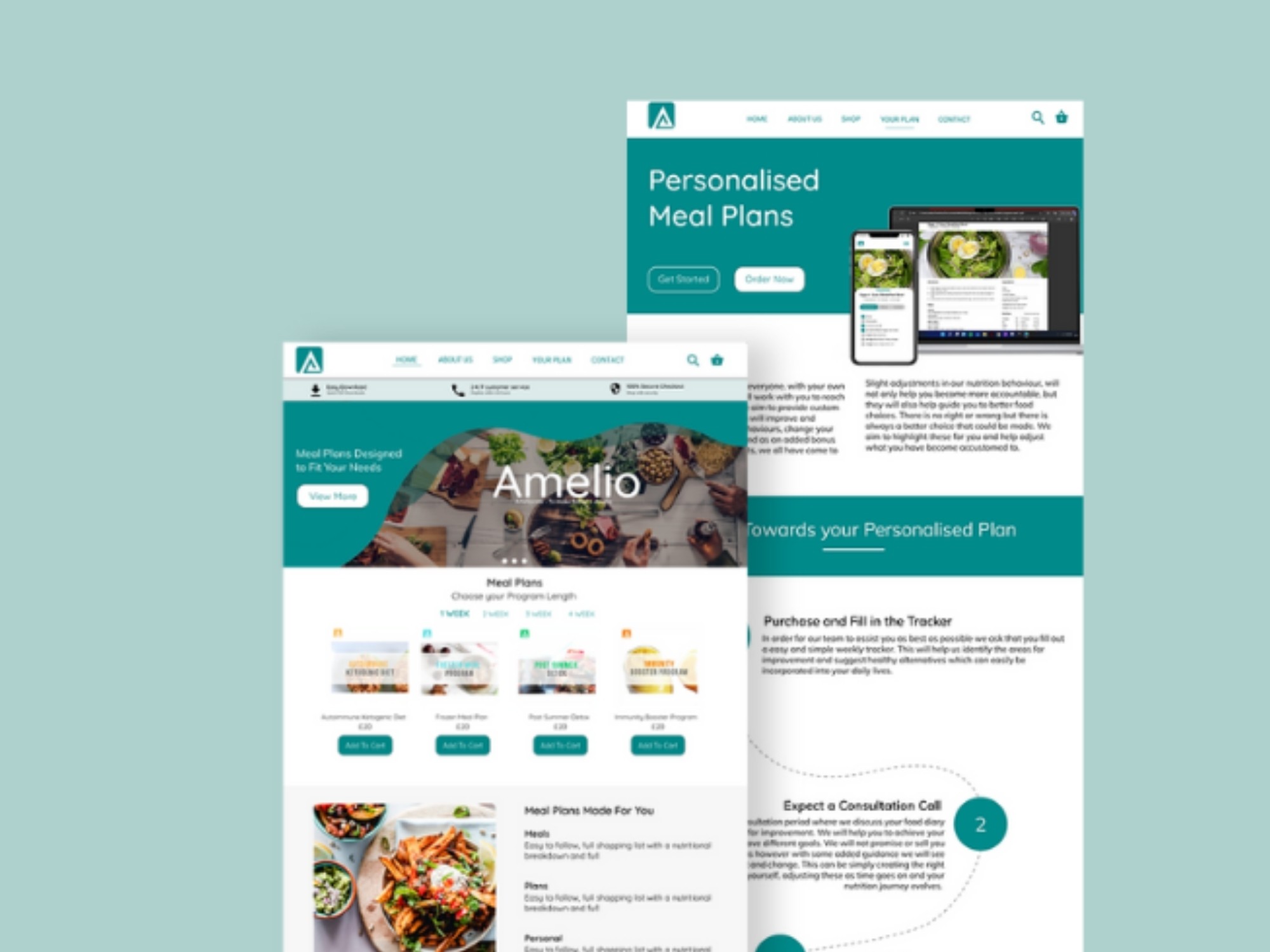
Amelio Nutrition

Conversion-Focused E-commerce Platform Designed to Simplify Nutritional Eating

Role:

UI/UX Designer

Timeline:

2 months (2023)

Tools:

Figma, Shopify, Google Forms

Overview

Despite the growing interest in plant-based diets, many individuals face obstacles such as lack of knowledge, limited recipe options, and concerns about nutritional adequacy. Amelio Nutrition was designed to address these pain points by creating an intuitive platform that educates and motivates users towards sustainable eating habits.

The objective was to design a user-centric mobile application that simplifies the transition to a plant-based diet by providing personalised meal recommendations, tracking environmental impact, and fostering community support.

The goal: increase checkout conversion while building trust with health-conscious consumers who are sceptical of supplement marketing. This project focused on creating a calming, trustworthy e-commerce experience — combining nutrition-driven user flows, targeted personas, and a flexible interface for desktop and mobile users.

The Problem

User Pain Points

  • Lack of knowledge about plant-based nutrition made transitioning feel overwhelming

  • Limited recipe options and meal variety led to diet fatigue and drop-off

  • Concerns about nutritional adequacy — users worried about missing essential nutrients

  • No single platform combined meal planning, environmental tracking, and community support

  • Existing apps felt generic and didn't offer personalised recommendations

Business Goals

  1. Create a user-centric mobile app that simplifies plant-based diet transition

  2. Provide personalised meal recommendations based on individual goals and preferences

  3. Track and visualise environmental impact of dietary choices

  4. Foster community support to maintain long-term engagement

  5. Differentiate from competitors through superior personalisation and content delivery

User Personas

Maya
28

Marketing & fitness enthusiast

High Tech Savviness

"I want to eat more plant-based but I'm worried I won't get enough protein for my workouts."

  • Overwhelmed by conflicting nutrition information online

  • Existing apps don't account for fitness-specific dietary needs

  • Meal prep feels time-consuming without proper planning tools

PAIN POINTS
  • Transition to a plant-based diet without sacrificing nutritional goals

  • Get personalised meal plans that fit her active lifestyle

  • Track her environmental impact to stay motivated


GOALS
Clive
38

Father of two & part-time chef

Moderate Tech Savviness

"I'd love to cook more nutritious meals for my family, but I don't know where to start."

  • Recipe apps don't filter for family-sized, kid-friendly options

  • Worried about nutritional gaps for children on a plant-based diet

  • Limited time for research and meal experimentation

PAIN POINTS
  • Find family-friendly plant-based recipes that his kids will enjoy

  • Understand nutritional balance for a growing family

  • Simplify weekly meal planning and grocery shopping

GOALS

Design Process

PHASE 6

Implement

Iterated designs based on testing insights and prepared final deliverables.

  • Added 'Meal Plans' section directly under hero — users expected pricing earlier in the journey

  • Improved visibility of 'Steps Towards Your Personalised Plan' section with numbered icons for scannability

  • Refined downloadable PDF meal plan format based on strong positive feedback

  • Finalised design system and prepared handoff documentation

PHASE 5

Test

Conducted remote usability testing to validate design decisions.

  • Recruited 5 participants matching target demographic (health-conscious, 25–35 age range)

  • Ran remote usability testing via Zoom using Figma prototypes

  • Tested: find a personalised meal plan, understand 'How It Works', navigate to other plan types, locate pricing/consultation options, view charts

  • Collected both quantitative task-completion data and qualitative feedback

PHASE 4

Prototype

Built interactive Figma prototypes for the core user flows.

  • Created high-fidelity prototype of onboarding and personalised plan flow

  • Designed 'How It Works' explainer section with step-by-step visuals

  • Built meal plan browsing and download experience (PDF format)

  • Prototyped consultation booking and pricing page layouts

PHASE 3

Ideate

Explored solutions for personalisation, meal planning, and habit formation.

  • Designed personalised onboarding quiz flow for dietary preferences and goals

  • Sketched meal plan recommendation engine UI

  • Explored environmental impact dashboard visualisations

  • Developed 'How It Works' section concepts for building user confidence

PHASE 2

Define

Synthesised research into clear user needs and product requirements.

  • Created user personas representing key target demographics

  • Mapped user journeys from onboarding to long-term engagement

  • Defined core feature set: personalised plans, environmental tracking, community

  • Established design principles: simplicity, trust, motivation

PHASE 1

Empathise

Researched user motivations, barriers, and existing market solutions for nutrition platforms.

  • Conducted competitive analysis of My Menu Coach, 3Natural Bionutrition, The Protein Works, and Exante

  • Distributed user surveys to understand dietary transition barriers

  • Reviewed app store reviews for competing nutrition apps

  • Identified gaps in personalisation, community features, and content delivery across competitors

PHASE 6

Implement

Iterated designs based on testing insights and prepared final deliverables.

  • Added 'Meal Plans' section directly under hero — users expected pricing earlier in the journey

  • Improved visibility of 'Steps Towards Your Personalised Plan' section with numbered icons for scannability

  • Refined downloadable PDF meal plan format based on strong positive feedback

  • Finalised design system and prepared handoff documentation

PHASE 5

Test

Conducted remote usability testing to validate design decisions.

  • Recruited 5 participants matching target demographic (health-conscious, 25–35 age range)

  • Ran remote usability testing via Zoom using Figma prototypes

  • Tested: find a personalised meal plan, understand 'How It Works', navigate to other plan types, locate pricing/consultation options, view charts

  • Collected both quantitative task-completion data and qualitative feedback

PHASE 4

Prototype

Built interactive Figma prototypes for the core user flows.

  • Created high-fidelity prototype of onboarding and personalised plan flow

  • Designed 'How It Works' explainer section with step-by-step visuals

  • Built meal plan browsing and download experience (PDF format)

  • Prototyped consultation booking and pricing page layouts

PHASE 3

Ideate

Explored solutions for personalisation, meal planning, and habit formation.

  • Designed personalised onboarding quiz flow for dietary preferences and goals

  • Sketched meal plan recommendation engine UI

  • Explored environmental impact dashboard visualisations

  • Developed 'How It Works' section concepts for building user confidence

PHASE 2

Define

Synthesised research into clear user needs and product requirements.

  • Created user personas representing key target demographics

  • Mapped user journeys from onboarding to long-term engagement

  • Defined core feature set: personalised plans, environmental tracking, community

  • Established design principles: simplicity, trust, motivation

PHASE 1

Empathise

Researched user motivations, barriers, and existing market solutions for nutrition platforms.

  • Conducted competitive analysis of My Menu Coach, 3Natural Bionutrition, The Protein Works, and Exante

  • Distributed user surveys to understand dietary transition barriers

  • Reviewed app store reviews for competing nutrition apps

  • Identified gaps in personalisation, community features, and content delivery across competitors

Research & Discovery

Methods Used
Icon

Competitive analysis of 4 nutrition/meal planning platforms

Icon

Remote usability testing with 5 participants via Zoom (Figma prototypes)

Icon

Task-based testing across 5 core user flows

Icon

User surveys on plant-based diet transition barriers

Icon

App store review analysis for competing nutrition apps

5

Competitors lacked consistent personalisation — most offered generic plans without accounting for individual goals or dietary restrictions

4

The downloadable PDF meal plan format was a standout feature — users found it practical, trustworthy, and easy to use

3

3 out of 5 users initially missed the 'Steps Towards Your Personalised Plan' section due to placement — iterated with numbered icons for scannability

2

The 'Get Started' CTA on the personalised plan page was a highlight — users noted it made the experience feel tailored and direct

1

Users expected pricing information earlier in the journey — added 'Meal Plans' section directly under the hero for transparency

Key Insights

5

Competitors lacked consistent personalisation — most offered generic plans without accounting for individual goals or dietary restrictions

4

The downloadable PDF meal plan format was a standout feature — users found it practical, trustworthy, and easy to use

3

3 out of 5 users initially missed the 'Steps Towards Your Personalised Plan' section due to placement — iterated with numbered icons for scannability

2

The 'Get Started' CTA on the personalised plan page was a highlight — users noted it made the experience feel tailored and direct

1

Users expected pricing information earlier in the journey — added 'Meal Plans' section directly under the hero for transparency

Key Insights

Prototyping Journey

Stage 1
Low-Fidelity

Initial sketches exploring onboarding quiz flows, meal plan layouts, and environmental impact dashboard concepts.

Initial sketches exploring onboarding quiz flows, meal plan layouts, and environmental impact dashboard concepts.

Stage 2
Stage 2
Mid-Fidelity
Mid-Fidelity

Digital wireframes for personalised plan pages, 'How It Works' section, and consultation booking flow.

Digital wireframes for personalised plan pages, 'How It Works' section, and consultation booking flow.

Stage 3
High-Fidelity

Interactive Figma prototypes used in usability testing — covering onboarding, meal plan browsing, PDF download, and pricing.

Interactive Figma prototypes used in usability testing — covering onboarding, meal plan browsing, PDF download, and pricing.

Personalised onboarding quiz as primary entry point

Rationale: Competitive analysis revealed most platforms offered generic plans. A tailored quiz immediately differentiated Amelio and made users feel the experience was built for them.

Meal Plans section placed directly below the hero

Rationale: Usability testing showed users expected pricing and plan options earlier in the journey — burying them reduced trust and increased bounce.

Numbered steps with icons for 'How It Works'

Rationale: 3/5 testers initially missed the section. Adding numbered icons and improving visual hierarchy increased scannability and comprehension.

Downloadable PDF format for meal plans

Rationale: Users strongly preferred a tangible, offline-accessible format over in-app-only plans — PDFs felt practical, trustworthy, and shareable.

Environmental impact tracking as a core feature

Rationale: Research showed sustainability motivation was a key driver for plant-based adoption — making impact visible reinforced positive behaviour change.

Design Decisions

Design Decisions

Personalised onboarding quiz as primary entry point

Rationale: Competitive analysis revealed most platforms offered generic plans. A tailored quiz immediately differentiated Amelio and made users feel the experience was built for them.

Meal Plans section placed directly below the hero

Rationale: Usability testing showed users expected pricing and plan options earlier in the journey — burying them reduced trust and increased bounce.

Numbered steps with icons for 'How It Works'

Rationale: 3/5 testers initially missed the section. Adding numbered icons and improving visual hierarchy increased scannability and comprehension.

Downloadable PDF format for meal plans

Rationale: Users strongly preferred a tangible, offline-accessible format over in-app-only plans — PDFs felt practical, trustworthy, and shareable.

Environmental impact tracking as a core feature

Rationale: Research showed sustainability motivation was a key driver for plant-based adoption — making impact visible reinforced positive behaviour change.

Final Designs

Accessibility & Inclusion

Focus states on all interactive quiz elements

Focus states on all interactive quiz elements

Keyboard-navigable quiz flow and meal plan browsing

Keyboard-navigable quiz flow and meal plan browsing

4.5:1 contrast ratio across the full colour palette

4.5:1 contrast ratio across the full colour palette

Form labels and error messages announced to screen readers

Form labels and error messages announced to screen readers

Touch targets minimum 44px on mobile for all interactive elements

Touch targets minimum 44px on mobile for all interactive elements

Alt text on all food imagery and environmental visualisations

Alt text on all food imagery and environmental visualisations

Outcomes & Impact

5/5

Testers successfully completed the personalised plan flow

92%

Task completion rate across all 5 tested user flows

PDF

Meal plan download rated most practical feature by all participants


4

Key competitors analysed to identify differentiation opportunities

Reflection

What I Have Learned

  • Usability testing with just 5 participants uncovered critical layout issues that would have reduced engagement in production

  • Users judge credibility by information architecture — pricing placement matters as much as visual design

  • Personalisation is the strongest differentiator in a crowded market — generic plans feel interchangeable

  • Downloadable, offline-accessible formats build trust that purely digital experiences often miss

What I Would Improve

  • Would conduct A/B testing on the onboarding quiz length — shorter vs. more detailed to measure completion vs. personalisation quality?

  • Would add social/community features to support long-term habit formation beyond individual meal planning?

  • Would exploring integration with grocery delivery services for a seamless plan-to-purchase experience?

Interested in working together?

I'd love to discuss how I can bring this same rigorous, human-centred approach to your team.